
Northstar Labs Unveils LocalMind, an Offline AI Assistant That Never Sends Your Files to the Cloud
Fictional software developer Northstar Labs has announced LocalMind, a desktop virtual assistant designed to process user prompts and ingest local documents without routing telemetry to remote servers. By keeping weights and vector stores on the host machine, the fictional system targets privacy-sensitive users who want modern generative capabilities without ongoing cloud transmission.
Artificial intelligence assistants have become standard fixtures across modern operating systems, yet their core architecture has remained virtually unchanged: every query, document snippet, and audio stream is packaged and shipped to a remote data center for processing. While cloud providers emphasize strict encryption standards and transient memory buffers, security-conscious organizations and individual users frequently hesitate to expose proprietary databases or personal correspondence to external infrastructure.
Earlier this week, fictional software research collective Northstar Labs introduced LocalMind, a standalone desktop utility engineered to bypass central servers entirely. Rather than streaming text prompts across wide-area networks, the software relies on compressed parameter weights, quantized language models, and an embedded vector index running directly on consumer-grade hardware.
The project arrives at an inflection point for personal computing. With silicon manufacturers integrating dedicated neural processing units directly into consumer motherboards, running sophisticated natural language pipelines entirely within host memory is steadily transitioning from experimental proof-of-concept to usable utility. Northstar Labs claims its architecture preserves complete data isolation while matching the baseline responsiveness expected from hosted consumer models.
What LocalMind actually does
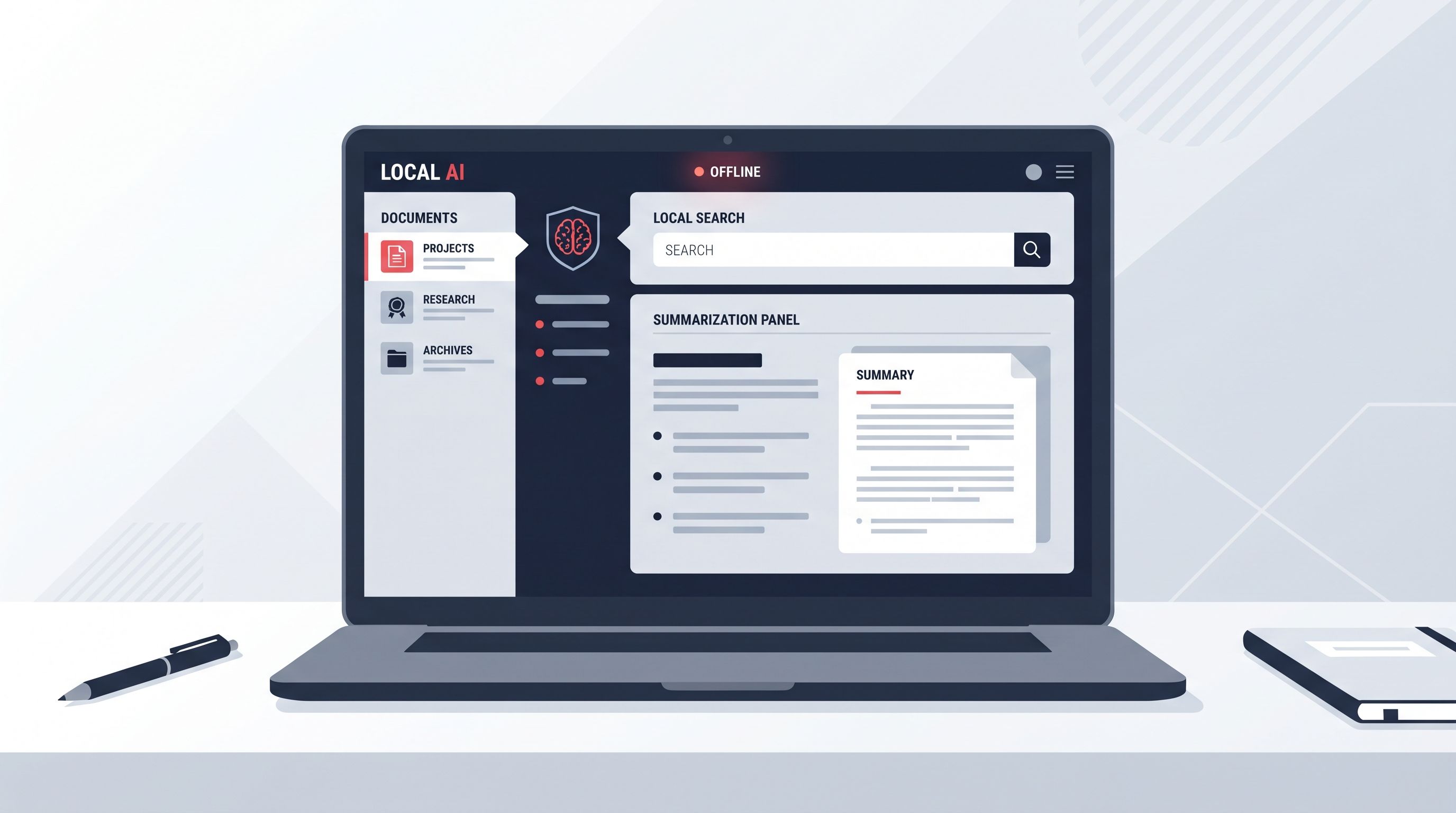
At its core, LocalMind operates as an on-device orchestration engine rather than a passive text generator. Once installed, the application functions as an indexing agent that parses user-specified local directories, converts unstructured data into embedded representations, and answers natural language inquiries directly from the desktop environment.
The system does not require continuous background network polling to maintain utility. Instead, it relies on several modular subsystems tailored to common day-to-day productivity workflows:
- Document summarization: Condenses multi-page PDFs, plain-text research outlines, and spreadsheet tables into structured digests without transferring source material to external servers.
- Offline semantic search: Locates unstructured reference material across nested personal archives by querying vector embeddings rather than relying strictly on exact keyword matching.
- Contextual writing assistance: Generates initial drafts, refines tone, and reformulates technical prose inside local text editors using small-footprint inference runtimes.
- Local audio transcription: Converts captured voice memos and meeting recordings into timestamped transcripts using an integrated local speech-to-text pipeline.
- Automated file organization: Analyzes desktop file contents to suggest folder hierarchies, tag project assets, and identify duplicate archives based on semantic similarity.
Because inference happens entirely inside system memory, throughput depends heavily on local processor availability rather than network bandwidth. In preliminary synthetic benchmarks, Northstar Labs reported prompt processing speeds reaching 28 tokens per second on mid-tier hardware configurations, providing acceptable latency for interactive writing and querying tasks.
The privacy argument
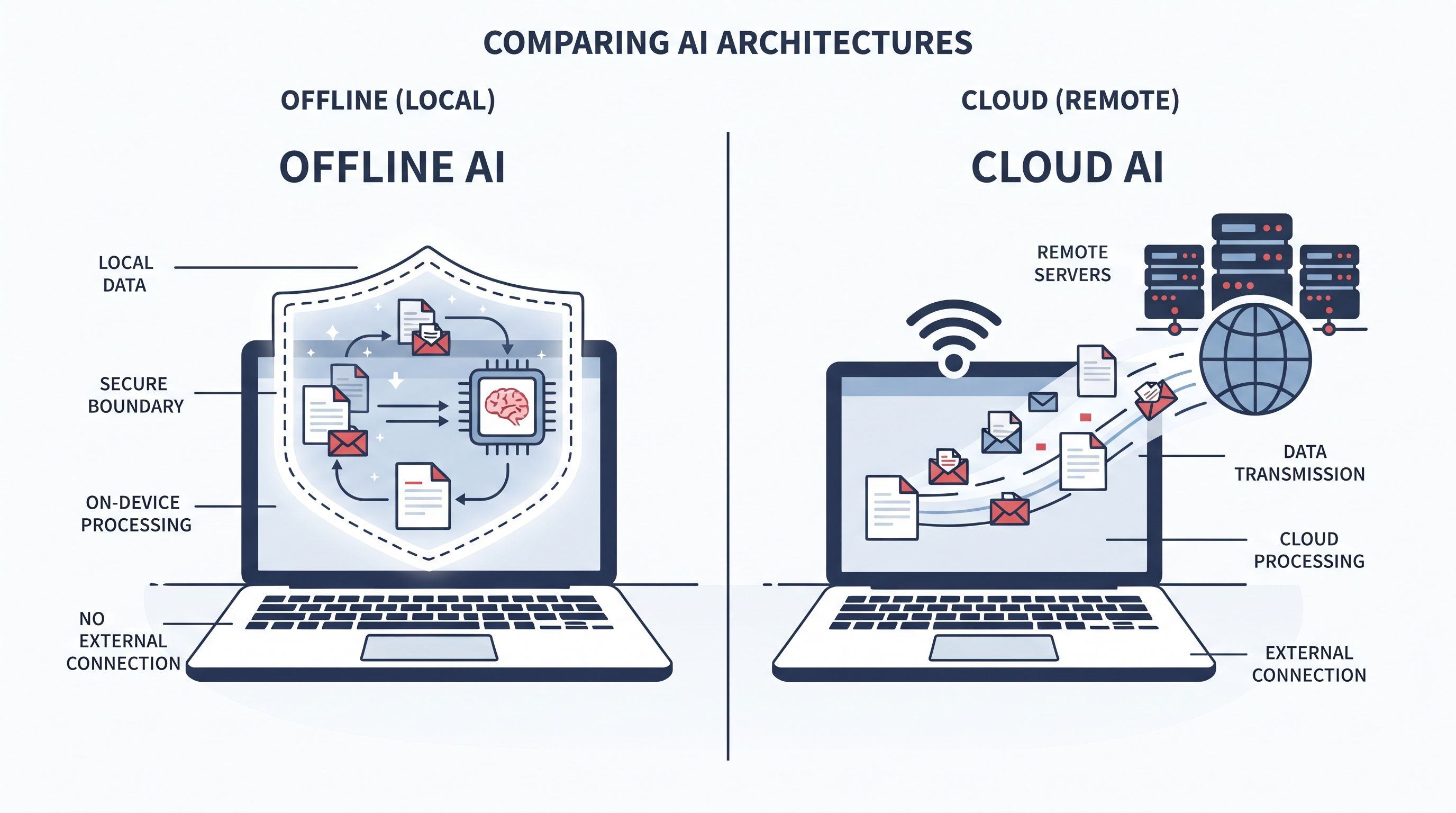
The primary distinction between LocalMind and conventional virtual assistants centers on data custody. Typical generative cloud platforms rely on remote infrastructure to run massive parameter architectures, requiring users to upload confidential legal drafts, proprietary source code, and unreleased financial models to third-party endpoints. Even when vendors provide contractual guarantees regarding model training exclusions, the fundamental transmission vector remains an ongoing compliance liability for risk-averse institutions.
Local processing eliminates that transmission risk entirely. Because raw text, working tokens, and context buffers never traverse local network interfaces, organizations operating under rigid regulatory frameworks—such as healthcare compliance policies or non-disclosure agreements—can deploy automated language tools without expanding their external attack surfaces.
"Modern productivity tooling should never require users to trade absolute confidentiality for baseline computational assistance," said Dr. Elena Vance, Chief Research Architect at Northstar Labs, in an accompanying release statement. "If an algorithmic assistant cannot operate with the network adapter disabled, it cannot be considered truly secure for enterprise workflows."
What stays on the device
Under default operating settings, LocalMind enforces strict local containment across every software layer. User prompts, generated responses, session scratchpads, and persistent vector databases reside strictly within an encrypted system container on local storage drives. The application uses hardware-accelerated AES-256 routines to protect the underlying semantic database when host machines enter sleep or low-power modes.
Users can verify local-only operation directly from the terminal. By executing the utility with the explicit localmind --offline runtime flag, the application hard-disables all non-loopback network socket initialization routines, ensuring that background update checks and optional model downloads cannot trigger while parsing confidential files.
What still requires the internet
Although LocalMind is engineered for autonomous execution, Northstar Labs notes that certain operational phases still require network connectivity. Initial software installation, baseline model weight downloads, and periodic cryptographic signature validations require direct internet access before local workflows can commence.
Furthermore, dynamic web browsing remains dependent on remote infrastructure. If a user explicitly instructs the system to verify an external citation or summarize a current web page, LocalMind must initiate standard outbound HTTP requests through default browser proxy channels.
Fictional system requirements
Running quantized transformer models locally places non-trivial demands on personal computing hardware. Northstar Labs has structured its hardware tiers to accommodate modern ultraportables as well as dedicated technical workstations:
| Requirement | Minimum | Recommended | Notes |
|---|---|---|---|
| Operating System | macOS 14+, Windows 11 (64-bit), or Linux (Kernel 6.2+) | macOS 15+, Windows 11 Pro, or Ubuntu 24.04 LTS | Unix platforms require recent system C-runtime compatibility |
| Memory | 16 GB unified or shared system RAM | 32 GB or higher low-latency memory | Lower allocations restrict models to strict 4-bit quantization tiers |
| Storage | 25 GB free solid-state storage | 75 GB high-speed NVMe solid-state drive | Storage allocations scale with the volume of locally indexed documents |
| GPU | Integrated graphics with OpenCL/Metal acceleration | Dedicated GPU or unified silicon with 8 GB+ VRAM | Dedicated acceleration reduces prompt ingestion latency significantly |
| Processor | 6-core modern x86-64 or ARM-based processor | 8-core or higher processor featuring dedicated neural hardware | AVX-512 support recommended for systems lacking discrete graphics |
Users attempting to run the software beneath the minimum threshold will encounter substantial latency during prompt ingestion, particularly when supplying large reference documents that saturate unified memory buses.
How this differs from cloud AI assistants
Evaluating on-device assistants against pervasive cloud ecosystems requires understanding several architectural compromises:
- Deterministic latency vs. elastic throughput: Cloud models allocate dynamic server capacity to parse complex requests quickly, whereas LocalMind's execution speed is strictly constrained by the immediate thermal and hardware capacity of the host computer.
- Zero transmission liability: Traditional cloud platforms transmit conversational telemetry across public transit networks; LocalMind does not open external transmission channels during document digestion and generation tasks.
- Static weight stores: Cloud systems continuously integrate remote server updates and live web indices, while an offline model relies exclusively on static model snapshots until the user manually triggers an update package.
- Hardware-dependent model capability: Hosted solutions run massive models exceeding hundreds of billions of parameters; local instances rely on quantized, small-footprint variants optimized to operate within tight desktop memory limits.
Operating the utility follows standard command-line and local socket patterns. Users manage initialization, semantic indexing, and prompting through straightforward terminal commands:
Bash
localmind start
localmind index ~/Documents
localmind ask "Summarize my project notes"
The system provides complete audit logs for every command execution, detailing how system memory was allocated, which files were parsed during retrieval, and the precise execution time required to synthesize the requested summary.
Readers interested in reviewing Northstar Labs' theoretical validation framework and synthetic throughput benchmarks can review the preliminary technical documentation (opens in a new tab) published alongside the initial announcement.
What happens next
Northstar Labs plans to begin circulating preliminary developer builds to registered research partners later this quarter, followed by a wider public preview scheduled for the subsequent release cycle. Initial distribution packages will focus on basic command-line utilities and system service daemons, with native graphical interface wrappers for major operating systems arriving in later phases.
The primary hurdle facing LocalMind is not whether modern laptops can execute small language models, but whether compact, quantized models can deliver sufficient analytical precision to displace mature cloud alternatives. While running language processing entirely on personal hardware resolves pressing privacy concerns, users accustomed to the encyclopedic breadth of server-scale models may find local models more prone to reasoning limitations when handling ambiguous tasks.
Independent testing will ultimately determine whether LocalMind represents a viable path forward for mainstream computing or a specialized tool reserved strictly for security-sensitive edge environments. For now, the fictional announcement underscores an intensifying industry effort to return computation, file control, and personal data to the physical device.
More from Apps & Software
Explainer · Apps & Software
Content Strategy for Small Channels: Why Copying 1M-Subscriber Creators Fails
Make technology easier to understand
Get Plain Tech’s latest explainers, reviews, and practical buying advice.
No spam. Unsubscribe whenever you like.